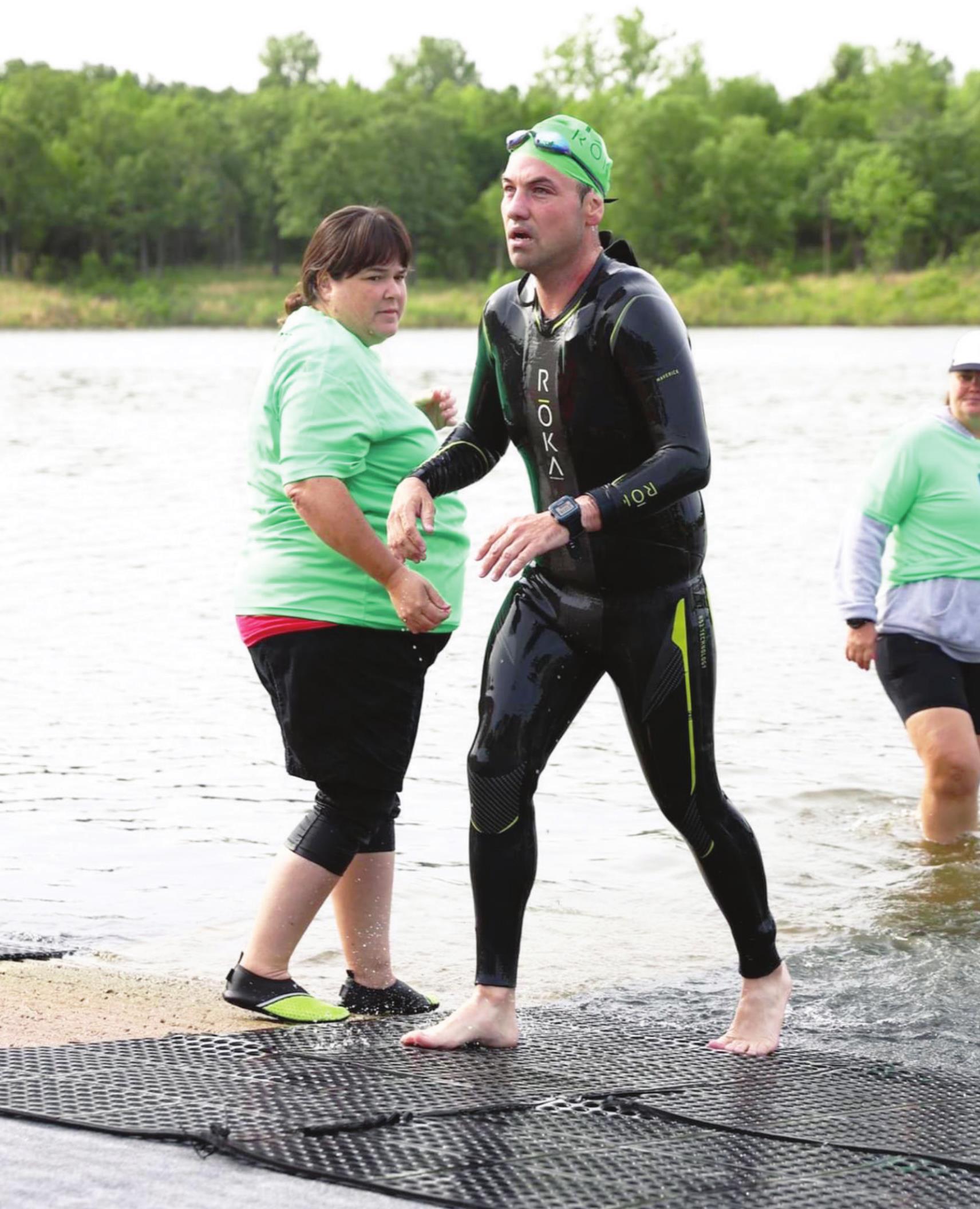
In May, Elmore City native Chris Figueroa completed his first Ironman triathlon in Tulsa, becoming part of an elite group of athletes who have earned the title of “Ironman.”
“It’s a very small percentage of people who will even attempt an Ironman in their lifetime,” Chris said.
And the percentage of people who will finish an Ironman triathlon, which consists of a 2.4-mile swim, a 112-mile bicycle ride, and a 26.2-mile run, is even smaller – estimated at 1% of the total population.
Chris admits growing up, he was not the most obvious contender for an Ironman triathlon.
“I wanted to stay on the computer. I hated any kind of being outside or being active or anything like that. Absolutely hated it,” he said. “If you had told 12-year-old Chris – or my mom. If you had told my mom, ‘At 35, Chris is going to compete in an Ironman,’ she would have had a heart attack.”
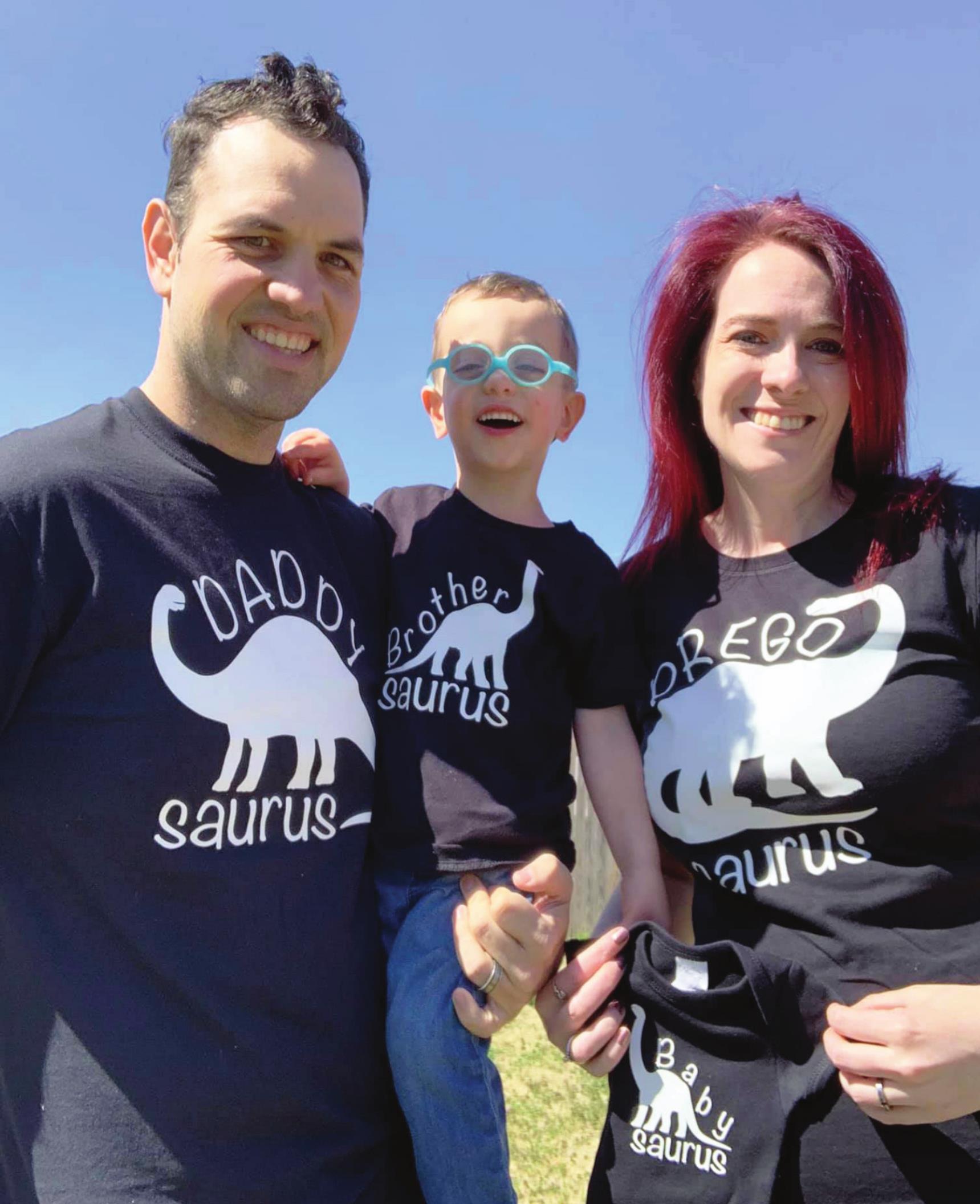
Chris, who now lives with his wife and children in Yukon, said he was inspired to enter triathlon races as an adult after going with his youngest sister, April, to hear Amy Downs speak at a church in Norman, Oklahoma, several years ago.
Amy was one of the last survivors to be pulled from the rubble of the Alfred P. Murrah Building after the 1995 Oklahoma City bombing. After being rescued, she embraced her second chance, going back to college and finishing her degree, losing a significant amount of weight, and becaming an Ironman triathlete.
At the time Chris heard her speak, Amy had just completed the Redman triathlon in Oklahoma City.
He thought, “If Amy can do that, with everything she’s done, then I can do that, too.”
He signed up for an aquabike, which is a swim and bike combination race consisting of a 1.2 mile swim and 56-mile bike ride.
Though he’d been cycling long distances for a few years, the swim portion of the aquabike promised to be challenging.
“I’d never swam once. Like ever,” Chris said. “I had plenty of time to train, but up until that point when I signed up, I had never swam before.”
Chris and Amy eventually became good friends, competing in local triathlons together as part of a larger group of friends. That progressed to competing in a half Ironman, known as a 70.3 Ironman, in Arizona. Then in 2016 they decided to do a full Ironman triathlon.
“I can remember going and telling my wife, ‘Hey, we want to do an Ironman,’ and she was like, ‘you want to do a WHAT?” Chris said.
Chris signed up to do the 2017 Ironman Arizona race with Amy and two other friends and began a year-long intensive training regimen.
Chris’ whole family traveled to Arizona in the fall of 2017 to watch him compete in the race, which began with the swim event.
Ironman triathlons require athletes to complete each portion of the race under a certain time.
“That’s part of the thing that makes Ironman so prestigious. If you finish, we know you finished and you finished under the time cutoffs, because they will not let you go on if you don’t,” Chris said. “You have 2 hours and 20 minutes to finish the swim. I finished in 2 hours, 20 minutes and 12 seconds.”
He was pulled from the race.
“I was crushed,” he said. “You look forward to this for a year. You spend all this time and dedication training and everything. My whole family was there. They drove 14 hours to Arizona to watch me do a two-hour swim. I’m like this is not how this is supposed to go.”
Looking back now, he said he knows even if he had made it past the swim in that first race, he still wouldn’t have finished the triathlon.
His coach at the time was an accomplished Ironman athlete, who often coaches top-tier triathletes. Chris said the hard-pushing training style was just the wrong approach for him.
“I was so burned out, those last couple of bike rides, I didn’t even want to get on the bike anymore. I dreaded it,” Chris remembers. “They always say when you hate what you’re doing, you’re not in it for the right reason. I was just done.”
After the disappointment of the Arizona Ironman, Chris said he took some time off and then just tried to focus on getting back into cycling and rediscovering the joy in it.
In 2020, Ironman added a race in Waco, Texas. Chris decided to sign up to compete in the October 2021 race, along with his friend Sydney Haggins.
This time he tried to train smarter. He and his wife, Krysta, had welcomed their first child in 2018, which caused him to realign his priorities in terms of training.
He said when preparing for his first triathlon, training trumped everything.
“I was putting off family events. My training was my priority. We didn’t have kids at the time. I was like, ‘If Thanksgiving falls on my training, I’m not going. I’ve got my training,’” he said, mocking himself. “And I’m like where did that get me? Absolutely nowhere. And Krysta started to resent my training because of that.”
This time he promised himself and Krysta training would not take priority over family. Family would always come first. To keep that promise, he began getting up early to train for a couple of hours before heading to his job as a police officer for the Putnam City School District. That schedule allowed him to have the remainder of his day to spend with his family.
“It was brutal. It was so hard, but I got it done,” Chris said.
On race day for the Waco Ironman, as Chris reached the halfway point in the swim portion in the Brazos River, he said he realized he was short on time. The panic and anxiety of missing the swim cutoff again overtook him, and he tried to swim harder.
“My form went out the window. I’m swallowing river water, and I’m like in panic mode,” he said.
His final swim time was 2:20:25 – 25 seconds over the cutoff point.
Even though he would ultimately earn a DNF (did not finish) status for the race, staff at the transition point told him he could move on to the bike portion of the event if he wanted to.
“Krysta, I passed her, and she’s crying, she’s upset because she knew what this meant to me,” he said. “This was going to be the one! I trained so hard, so many miles, so many hours and this was going to be the one.”
He had spent so much energy on the swim and swallowed so much water he only made it 15 miles into the bike ride before he decided to leave the race course.
“It was such a buildup to do this, and then such a letdown to not be able to make it,” Chris said.
He stayed to cheer on his friend and training partner, Sydney, who completed the triathlon, before returning home.
In November of 2021, just a month after the Waco race, he got a message from Sydney asking him to give it one more try.
“Sydney sends me a message that says, ‘Do Tulsa.’” Chris said. “She’s said, ‘I will coach you, and I promise, whatever it takes, I’ll get you across that finish line.”
A new addition to the Ironman lineup, the Tulsa Ironman race was slated for May of 2022, and with Chris fresh off training for the Waco event, Sydney promised the training would be easier. He just needed to maintain until it was time to move into the peak training phase closer to race time.
After a week of encouragement from Sydney, he finally agreed to sign up for Tulsa. Then, he had to break the news to his wife.
“Really, Krysta has been so supportive. She’s never once complained about the time I’ve been gone or made me feel bad about the times I’ve been gone, because it is a huge commitment. … She believed in me that much and wanted me to do it that much – knew how much it meant to me – that she sacrificed all those times she had to get up early with the kids, or overnight with the baby so I could sleep in so I could be rested for the training.”
Because of the timing of the Tulsa Ironman, Chris found himself facing a winter training season, which meant swim training in a pool and the monotony of endless laps, something he said he has always dreaded.
“I had so many doubts and worries about that stupid swim. I had so much anxiety, but (Sydney) was like, ‘Don’t worry about it. Race day is going to be magical. It’ll all come into line.’”
By the time Chris reached the Peak phase of his training, Syndey was eight months pregnant and couldn’t physically train with him. During the week he had plenty of people to train with, but his motivation began to lag as he trained by himself on the weekends.
“This is the third time. You’d think the whole mental aspect of it would be easier, but swim for me got worse.”
Even going into the race, he felt defeated because of that swim.
“I didn’t let anyone know, but I had such a horrible attitude going into this race,” Chris said.
The morning before the race, Chris said he went to drop his bike off at the swim-to-bike transition point.
“We get out to the lake, and it is whitecapped. I mean that wind is just whipping, and that was my game-over moment. I had a complete meltdown with Krysta.” Chris said.
He texted Sydney, who simply responded, “Tomorrow’s going to be magical. That swim is going to be magical. It’s going to be okay.”
By race day, he said he was feeling encouraged. The wind was up and the water was choppy, but there were no whitecaps. The swim course was changed slightly at the last minute due to a buoy that had blown off-course. Instead of one 2.4-mile loop, participants would swim a 1.2-mile loop twice.
Chris completed the first loop in an hour and 2 minutes – 8 minutes ahead of where he needed to be to make the cutoff. At the end of the second loop, he still had the 8-minute leeway, finishing with a time of 2 hours, 12 minutes.
“Sydney said it was going to be magical, and it was,” he said.
But he still faced a 112- mile bike ride and a full marathon of 26.2 miles. Even though he’d made it to his first goal of the day – the one that really mattered for him – Chris said he still was not confident he would make it to the finish line.
He finished the bicycle leg with time to spare and set out on the marathon run, just mentally breaking up the distance into short 3-mile increments.
By mile 20, he said the day’s accomplishments began to sink in.
Between 10 and 11 p.m. he reached mile 22. Making some quick calculations, he knew he could afford to walk and still finish under time.
He kept an eye on his pace and began conversing with some of the other participants around him.
With two miles left to go, he finally realized he was going to finish under the cutoff time.
“I was like, ‘Oh my gosh, I’m actually going to do this,’” he said.
His friend Jamie, who had run with Chris in his first Ironman Arizona race, was at the last bridge on the course and walked the last mile with him.
He crossed the finish line at 11:30 p.m., 30 minutes before the final cutoff.
He would later write on his face book page, “Chris Figueroa, You. Are. An Ironman. Hearing Mike Riley say those words will be etched in my mind forever.”
Ruth, another friend who raced with him in Arizona, was at the finish line as a volunteer, and put the medal around his neck.
“It was one of the most incredible things. I went from feeling like death, to feeling this instant high just like that,” Chris said, snapping his fingers. Then he chuckled, “But then that instant death comes back pretty darn fast. I’ve never really hurt like that.”
Though he said he might return to Ironman as a race volunteer, he has no plans to compete in another triathlon of that length. For now, he said he plans to scale back for a while.
“I want to ride or run now because I want to, not because I have to,” he said.
When asked what he’s gained from his Ironman experiences, Chris doesn’t hesitate. “Friendships. And also, how to deal with failure,” he said – a lesson he hopes to pass on to his children.
“Life is full of failures. you’re going to fail. Things are going to go wrong. It’s how you handle yourself. Are you going to get back on the bike, or are you just going to quit? Life’s not easy. Ironmans aren’t easy. But just keep going when it gets hard,” he said. “If you find something you want to do, do whatever it takes to cross that finish line.”