Article courtesy of Oklahoma Monarch Society News
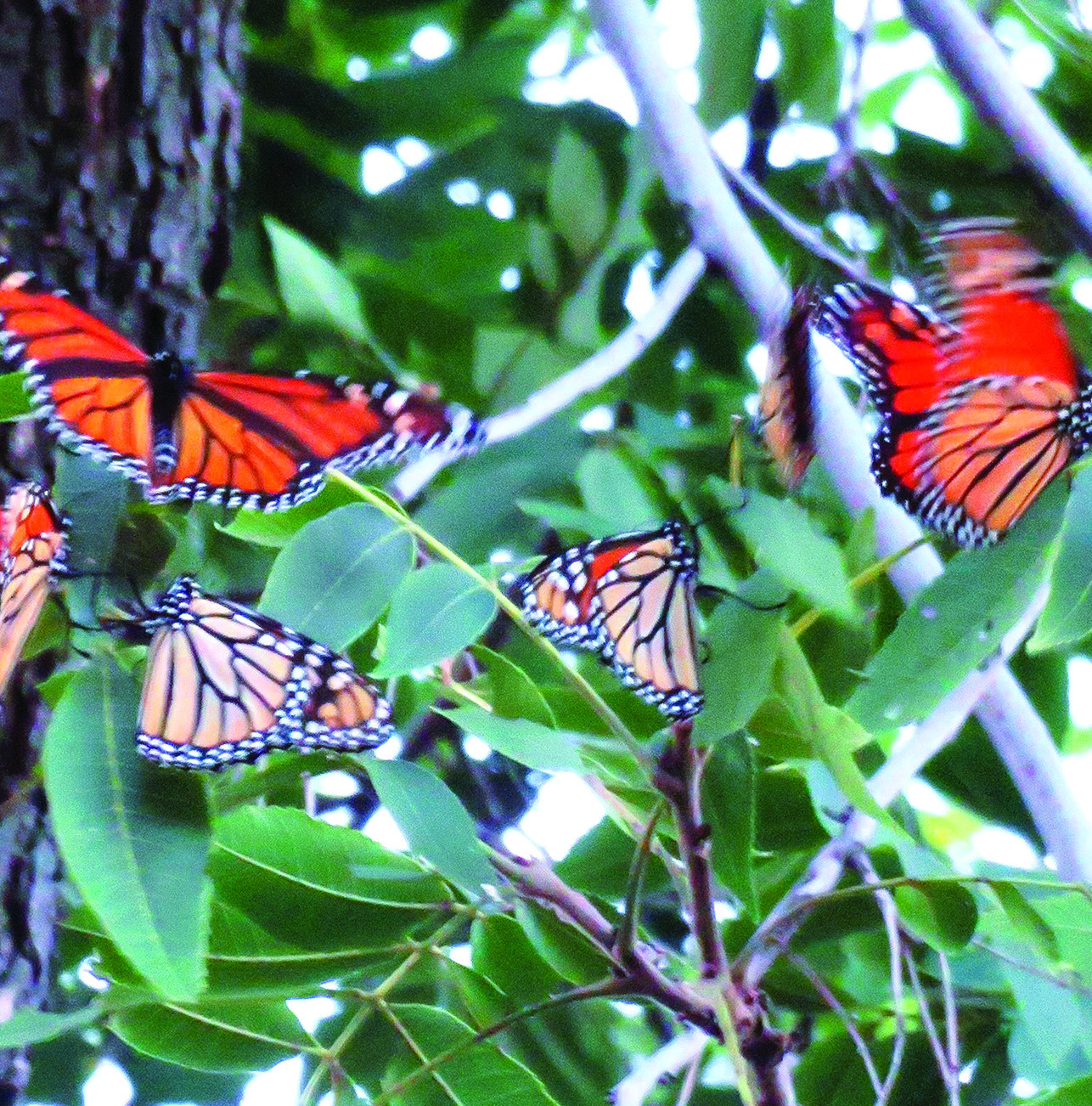
Here come the kaleidoscopes in the sky—groups of butterflies, that is, monarchs, to be specific.
Sonia Kirk knew to look for colors in her Oklahoma City backyard this week because a Facebook “12 years ago today” memory photo reminded her of a remarkable 30-year trend in her corner of the world.
“Then my husband walked in and said he saw one in the backyard, so I went out to look, and there they were,” she said.
Monarch roosts are unlike most butterfly sightings in the Sooner state.
“You might think they would be in the backyard and fly up into the trees, but they’re up high. You see them come in over the rooftops,” Kirk said.
As the sun set, more arrived, she said. They can become hard to see up in the mature pecan tree behind the couple’s home.
“I think we had about 30 that night,” she said as she counted past 10, and more arrived Thursday evening. “I think this spot is in their DNA. We used to get a lot more. When we moved here in 1994-95, it was probably over 1,000. Over the years, it’s gone back and forth, but we never had that many again, and it’s sad.”
Kirk reported her roost to Journey North, a citizen science project that tracks migrations. Six roosts, from Watonga to Oklahoma City, have been reported this week. The national map showed roosts reported from the Great Lakes region to Oklahoma this week. All the monarchs will be gathered at their Mexico sanctuary by late November.
“Now into mid-October, we can have some really busy migration days. Northerly winds are forecast for Tuesday, which could bring a push, so people should keep an eye out,” said Katie Hawk, executive director of the Oklahoma Monarch Society.
“Seeing a roost is really something special and relatively rare. Everyone wants to find a roost. Having six reported here this week is amazing,” Hawk said. “Most of us see monarchs in our backyards, but this time of year, if you see one in your yard, it’s a good idea to look up, too. You might spot groups over the treetops and even higher. Sometimes, they are so high they look like a tiny dot.”
“A group of butterflies is called a kaleidoscope, so that’s a fun way to remember them rather than as groups or flocks,” she said.
Three monarchs led Kayla Kuehn to kaleidoscopes, arriving to form roosts near her Watanga home Wednesday evening. At about 7 p.m., three crossed the road in front of her car, she reported via email.
“We follow the migration (online) and knew it was getting close, so we decided to stop and look at the trees on our road, expecting nothing since we had only sighted a total of three leading up to this day,” she said.
But she saw several monarchs flying near a cluster of trees and was soon counting a roost of about 100, and that wasn’t all.
“We jumped back in the car and drove down a few hundred feet to the next group of trees. We found as many, if not more, than at the first roost. We again found one more roosting area at the end of the mile section with nearly the same amount.”
This year is critical for monarchs, not just because the U.S. Fish and Wildlife Service has a deadline to decide by the end of the year whether the big, showy orange and black butterflies should be on the Endangered Species List. The 2023 migration suffered from widespread drought, so this is a crucial recovery year, and citizen scientists reporting their observations are as critical as ever, Hawk said.
“This is an all-hands-ondeck situation this year,” she said.
People can help by planting late-blooming flowers to fuel fall migrants with nectar and milkweeds to host the Oklahoma-raised caterpillars for the season’s last super monarchs that fly to Mexico, overwinter, and return next spring, Hawk said.
The Oklahoma “supers” are so-named because they are generally larger than monarchs that emerge in the summer months and because of the heroic journey they complete each winter.
Kirk said several neighbors have joined her in planting butterfly gardens since she became highly interested in the plight of monarchs about 15 years ago. While the migration continues over her home, she also has late-blooming flowers to feed the adults and milkweeds ready for caterpillars to transform into butterflies and catch the last wave of migration in mid-October.
“Several of us on our street are actively trying to help,” Kirk said.
The Oklahoma Monarch Society is a nonprofit consortium of more than 40 organizations, agencies, municipalities, and businesses in Oklahoma.