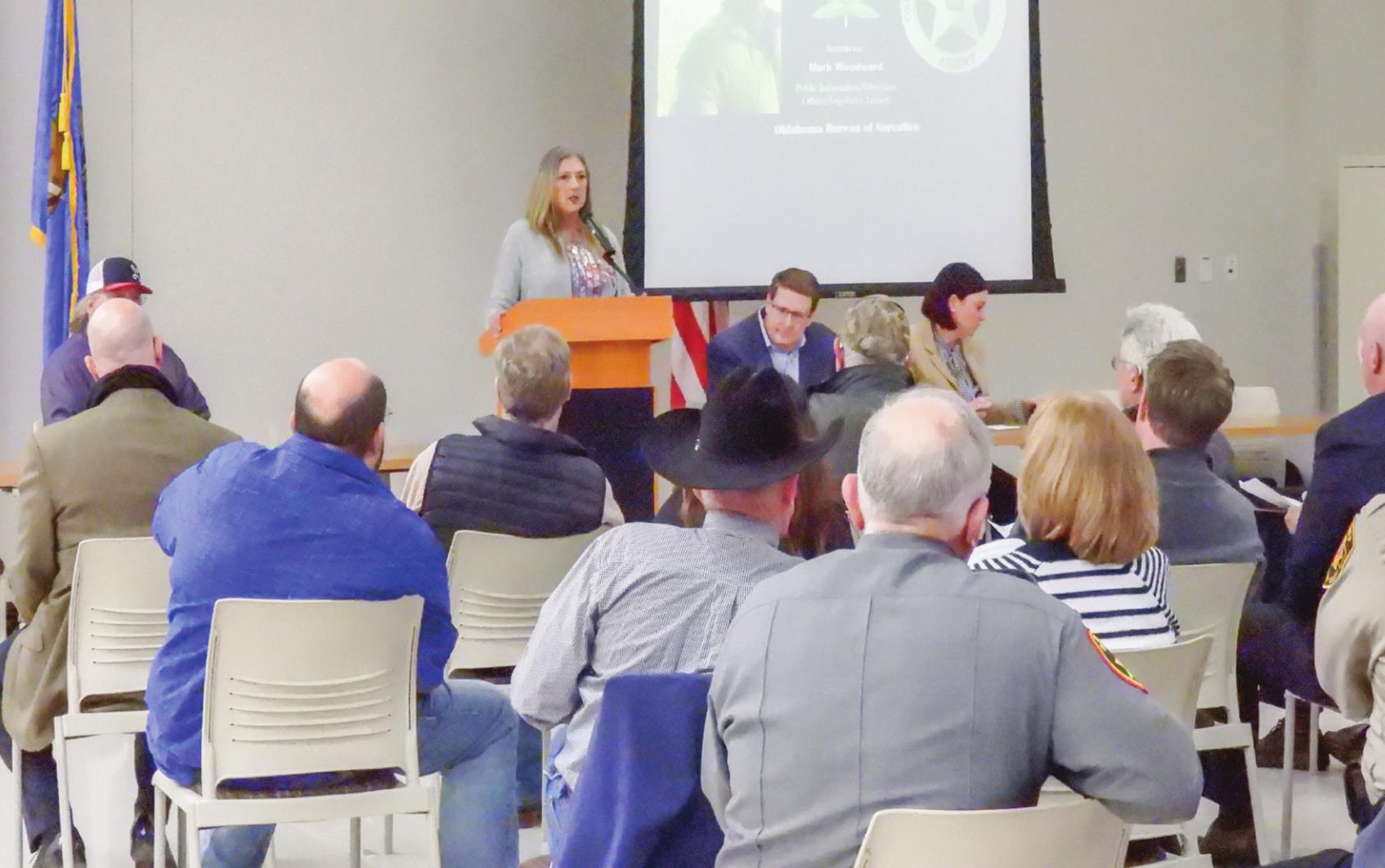
Editor’s Note: State Rep. Cindy Roe hosted a Marijuana Town Hall in Pauls Valley on Dec. 16. During the two-hour meeting citizens heard from state and local law enforcement, the director of OMMA, and state legislators. This is the first article in a multi-part series covering the information, concerns and solutions presented there. The rest of the series can be found here: Balancing act: promoting legal industry while eradicating black market marijuana, and OMMA focus turns to compliance.
Since Oklahomans voted to legalize medical marijuana in 2018, the state’s newest industry has been booming and more than 400,000 Oklahomans now hold patient cards. But law enforcement officials and legislators say deficiencies in the original initiative petition, including loose regulations and inexpensive licensing fees, have provided opportunity for complex criminal organizations to gain a toehold in the state.
Mark Woodward with the Oklahoma Bureau of Narcotics and Dangerous Drugs spoke at a Marijuana Town Hall meeting hosted by Rep. Cindy Roe in Pauls Valley earlier this month, laying out what his agency has seen develop in the state over the last 14 to 16 months in terms of criminal activity.
As a law enforcement entity OBN deals with criminal drug violations, not the regulatory side of the medical marijuana industry, and Woodward said for the first two years following the passage of State Question 788 and legalization of medical marijuana, the agency primarily was dealing with minor infractions such as security violations or people who had applied for a commercial license from the Oklahoma Medical Marijuana Authority but had failed to obtain a license from OBN, which is required for any business that deals with controlled dangerous substances.
During that period, OBN was working with business owners to help bring everyone into compliance as new businesses did their best to familiarize themselves with the law and the requirements of the fledgling industry that had just been introduced to the state.
Then last year things started to change, as more and more illegal operations, many run by complex criminal organizations, rushed into the state.
A combination of factors, including COVID-related shutdowns that displaced many West Coast agricultural workers, inexpensive land prices, cheap medical marijuana licenses and loose regulations on the medical marijuana industry, have created a “perfect storm” that is drawing illegal operations to the state, Woodward said.
Oklahoma currently has 8,500 growers, compared to a combined total of 2,400 growers in West Coast states with legalized marijuana laws, according to Woodward.
There are over 2,200 dispensaries in Oklahoma, Woodward said, which is also more than Colorado, Oregon, Washington, Alaska, New Mexico, California and Nevada combined.
“Needless to say, there are a lot of people who took advantage of our law, and there’s nothing wrong with that, but the thing is you’ve got to play by the same rules we set up for everybody else. And there were some people who started coming to Oklahoma last year, who felt Oklahoma’s laws do not apply to them,” Woodward said.
Oklahoma’s marijuana laws require product to be grown and sold within the state. Woodward said the three primary problem areas OBN is dealing with currently are products grown elsewhere being sold in the state, unlicensed growers, and criminal organizations who may be licensed but are illegally growing product for the black market and shipping it elsewhere.
About 10% of the cases OBN is investigating currently are unlicensed growers, Woodward said.
“They’re not even making an effort to get a license. They think they can go buy some land and hide out in the middle of nowhere in Oklahoma, grow, and move their product to the east coast. Some of them have been, and they’ve been very successful at it, because they’re hiding within this oversaturation and you can’t tell the bad guys from the good guys,” Woodward said.
But the more insidious threat is criminal organizations who are moving in, obtaining the proper licensure, and then shipping product illegally to the black market, specifically on the east coast.
“Talking to our law enforcement partners, federal and state, all up and down the east coast, especially in the northeastern part of the United States, Oklahoma is now the number one source-state for illegal marijuana. It used to be California, and then it started drifting into Colorado, and now everyone wants Oklahomagrown marijuana because it can be grown so cheap here,” Woodward said. “We’ve identified about 16 different countries that now have organizations in Oklahoma growing for criminal groups.”
Many of these organizations began moving into the state in the fall of 2020, and a lot of people didn’t realize what was happening as they began buying land and putting things into place. The one thing they lacked was residency. Oklahoma law requires 75% of the ownership in a medical marijuana business to have been an Oklahoma resident for two years, or for five consecutive years in the last 25 years. These groups were able to overcome this barrier by working with brokers or attorneys who stepped in and found “sham-owners” or “ghost-owners” that met residency requirements to put on license applications.
OBN started to identify these groups in the spring of 2021, as large farms continued to go up seemingly overnight, and often were filled with 2-foot-tall plants within two weeks. Woodward said he could comfortably estimate at least 2,000 farms in the state have been operating under a fraudulent or ghost-ownership structure, and more are continuing to be identified every day.
“These were the ones that started getting our attention because these are 100% illegal. Yes, they’ve got their license, but 100% of their product is not following the laws. It’s not going to somebody who can legally have it. And that’s when we started getting involved in these investigations, doing deep dives into these financial groups, their investors, their workers, the people moving the plants, moving the workers, buying the land, and we started hitting farms. And we hit this farm and that led us to another farm, and that leads us to another farm. We’ve hit probably 80-85 farms that we’ve shut down since April. Each one of those is tied to something much bigger,” Woodward said.
“These groups are very complex. They make it look very, very legit on the surface. They know how to hide the money; they know how to make it very clean. These are professional criminal groups that we are dealing with at the Bureau of Narcotics. These are not amateurs. They’re the same ones that have been bringing Fentanyl, Meth and other drugs out of Mexico and out of China. So, they know what they’re doing. They’ve been in business a very, very long time. They realize the potential, because if you can get to Oklahoma, you can grow marijuana for about $100 a pound. That $100 a pound is going for $4,000 a pound right now in Brooklyn, New York. So, they cannot get here fast enough.”
These illegal operations are introducing a plethora of other issues to rural communities including inflated property values, human trafficking and poor living conditions at grows, environmental contamination concerns, strains on rural water sources and energy grids, and collateral crimes like prostitution.
They are also hurting legitimate medical marijuana businesses who can’t compete because they are following the law, paying fair wages and other necessary costs for things like product testing.
As OBN is closing in on many of these organizations, Woodward said, some of them are getting “burner-licenses.” They know they have a limited amount of time to get in, grow, make their money and get out in the middle of the night before they get caught.
“We’re finding more and more of these abandoned grows where they’re leaving ten million dollars’ worth of equipment behind,” Woodward said. “A lot of these people who have gotten here criminally through this fraudulent business structure now realize that we’re on to them. And we are going after those brokers, we’re going after the law firms, we’re going after these groups and the people who were recruiting them. And when they start realizing we’re going after their licenses, a lot of them are splitting out of town, but they’ve already made millions.”
Woodward said OBN has recently gotten a commitment from legislative partners to use money from OMMA licensing fees to create a full-time marijuana enforcement unit. The unit will have 40 agents total, ten in each quadrant of the state, cooperating with local law enforcement, criminal analysts and attorneys to start working on asset forfeiture of farms, land and property, and seizing bank accounts, in an attempt to cripple the criminal organizations behind the illegal farms.
“People ask, ‘Why don’t you just go shut them down?’ Because if we do that we haven’t made a difference. We have to shut down the organization that is running that farm. Those people are not here in Oklahoma. They’re not sitting out on that farm. They’re orchestrating this from places like Los Angeles and New York and down in Mexico. And those people are being investigated,” Woodward said.
“We appreciate the patience the public is showing, but please know we are aware of what’s going on out there. And the message is getting back to these groups, too. We’re seeing more and more of them not renewing their licenses. Also, there’s a lot of criminal and civil actions that will be taking place in the courts probably in the next 14 to 16 months related to these brokers, these lawyers and these other people who were playing a role in getting these criminals to Oklahoma in these fraudulent business structures. So, things are changing, but it’s just going to take time,” Woodward said.