The severe storms that moved through the county last weekend served as a sobering reminder we are heading into the most active part of Oklahoma’s storm season.
While tornados can form any time of year, March to June is typically the most active time for tornadoes in Oklahoma, with April and May representing the peak of that activity.
According to the National Weather Service, in the 71-year period between 1950 and 2021 the state recorded 227 March tornados, 840 in the month of April, 1733 in May and 521 in June.
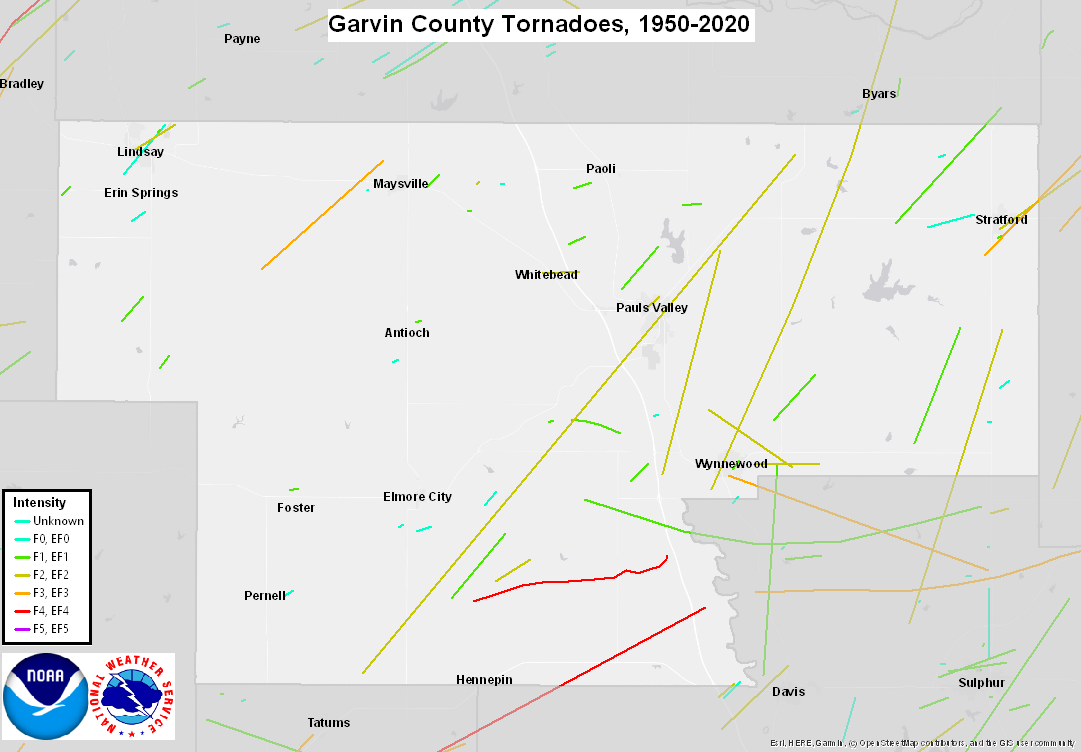
Those trends are similar to what Garvin County has seen for that same 71-year period. According to NWS records, Garvin County has recorded 57 tornados since 1950, with 30 of those – more than half – occurring in the month of May.
The county has seen 10 tornadoes in the month of April, and six in June over that same period. Garvin County has also recorded several early-season tornadoes, with five occurring in February, and two in the month of March. And proving that tornados can occur any time of year, the months of July, August, September, October and November have all had one recorded tornado.
Though all have been capable of producing damage, most of those have been smaller storms with wind speeds of 112 mph or less. Fourteen storms produced F2 or F3 tornadoes with wind speeds estimated between 113 and 206 mph. Two have been rated as F4 or EF4 tornadoes.
One of those occurred in 1972, touching down in Carter County near Ratliff City and traveling east-northeast into Garvin County, killing five people and injuring six others. The other occurred in 2016. That tornado touched down south of the community of Katie and traveled east-northeast for nine miles, resulting in one fatality.
Garvin County Emergency Management officials say the best way to protect yourself and your family during severe weather is to have a plan in place ahead of time.
“I’m a big fan of ‘Be prepared,’” Garvin County Emergency Management Director Dave Johnson said.
That plan should include where to seek shelter, what to do in case your property is damaged by a tornado and where family members should meet in case of storm damage.
Above-ground safe rooms and below-ground shelters are the safest place to be, Johnson said. If you don’t have access to a storm shelter, officials say you should seek shelter on the lowest level of your home, in a small interior room or closet with no windows. If possible, do not remain in a mobile home or a vehicle. Instead seek shelter in a permanent structure.
“Below ground is always going to be better than above ground,” Johnson said.
Many communities have access to public storm shelters, and in Garvin County those are centered around the schools. According to Garvin County Emergency Management, Pauls Valley Elementary School, Stratford Elementary and Middle School, Maysville High School, Lindsay Middle School and Grade School, Wynnewood Grade School and Middle School, and Elmore City-Pernell Elementary and High School all have public storm shelters.
Having access to a shelter or safe room is only part of the equation; actually getting in the shelter before it’s too late is also critical.
Johnson said while it may be tempting to stand outside and watch the storm, there are plenty of cases where someone had access to a shelter but died in a tornado because they didn’t get in it.
“It’s kind of like seat belts. They don’t work if you don’t wear them,” Johnson said.
Johnson recommends taking a flashlight and cell phone to your shelter or safe place. He also said if you have time, it’s always a good idea to call a designated family member or friend who lives away from the storm’s path to let them know you are seeking shelter and where.
If you have a storm shelter, be sure to register it with the county. This allows first responders to locate and check shelters after a storm moves through to make sure no one is trapped or hurt. Registration forms can be obtained from the county commissioners office on the first floor of the courthouse, 201 W. Grant in Pauls Valley.
Including the latitude and longitude of the shelter can help emergency services locate the shelter more quickly after a storm when visual locators such as signage and landmarks may be missing.
Residents can easily get latitude and longitude information from a smart phone mapping app.
“They can walk out to their shelter door and drop a pin, and it will give them the latitude or longitude,” Johnson said.
County officials can also help residents identify latitude and longitude information if needed when a shelter is registered.
You should also know how to get severe weather warnings and alerts for your area, especially in the overnight hours. Johnson said many people don’t realize storm sirens are designed to warn people who are outdoors when severe weather approaches, not those indoors, and should not be your primary source of warning.
Apps on your phone or device are a great way to receive up-to-date information and warnings in a specific area. Weather apps are available from local news stations or the National Weather Service. You can also get text warnings and updates from Garvin County 911. To receive those, text the name of your community’s school mascot to 888777. You can sign up for alerts from multiple communities in the county.