Editor’s Note: State Rep. Cindy Roe hosted a Marijuana Town Hall in Pauls Valley on Dec. 16. During the two-hour meeting citizens heard from state and local law enforcement, the executive director of OMMA and state legislators. This is the final article in a three-part series covering the information, concerns and solutions presented there. The rest of the series can be found here: 'A perfect storm': State sees surge of criminal organizations linked to illegal marijuana operations, and OMMA focus turns to compliance.
State Question 788, which legalized medical marijuana in Oklahoma, appeared on the same 2018 ballot as that year’s Gubernatorial election. In that election, 44,000 voters filled out only the state question portion of their ballot, declining to vote for any other item, including the Governor’s race, according to State Rep. Cynthia Roe, who spoke at a Marijuana Town Hall she hosted in Pauls Valley last month.
Several state legislators attended the Town Hall to hear comments and concerns from citizens ahead of the next legislative session which begins February 7.
“Probably 75% of the correspondence I get from constituents in my district are related to issues with medical marijuana,” Roe said in her opening remarks at the Town Hall meeting.
Those in attendance heard a sobering presentation from Mark Woodward with the Oklahoma Bureau of Narcotics and Dangerous Drugs, on what his agency is doing to combat criminal organizations that are hiding behind Oklahoma’s medical marijuana laws to grow for the black market. Oklahoma Medical Marijuana Authority Executive Director Adria Berry also spoke, explaining changes OMMA is making to ensure compliance and help OBN identify licenses issued to sham-ownership operations. (See the first two articles in this series at gcnewsstar.com).
Rep. Scott Fetgatter of Okmulgee, who serves in House District 16, spoke to several of the issues raised by citizens during the Town Hall. Fetgatter has worked on several legislative measures to help regulate the medical marijuana industry in Oklahoma since the passage of SQ 788 in 2018, and in the process has become a resource for information for many legislators when it comes to issues surrounding the medical marijuana industry in the state.
Though he campaigned against SQ 788, Fetgatter said his approach in the three years since legalization has been to try to regulate from a standpoint that recognizes the medical marijuana is now a legal industry in the state of Oklahoma. And Oklahoma is not the first, he said, pointing out that at least 40 states currently have some form of legalized marijuana.
“It’s hard to pass medical marijuana legislation at the capitol. There’s a lot of different opinions on it,” Fetgatter said. “It’s not going away. It’s not going to be repealed. It’s not going to get smaller. It’s only going to get bigger and at some point, probably in the near future, it’ll be federally legalized. So, we have to look at it and say, ‘We have legal business owners who have made an investment, and they’re betting they are going to be successful in this new industry. So, how do we manage this program while offering opportunity for legal businesses to be successful, and we kill the black market?’”
Fetgatter contends part of the problem has been a “low barrier” to enter the industry in Oklahoma.
“The barrier of entry into the marijuana industry in the state of Oklahoma is $2,500. If you got a skateboard and a backpack with 2,500 bucks in it, and you don’t have a felony in the last two years, I believe it is, and you haven’t been arrested in the state of Oklahoma for two years, you can skateboard yourself down there and you can get a license and OMMA doesn’t have the authority to tell you no. That’s a problem. They have no vetting process,” Fetgatter said.
Fetgatter said he is considering running legislation this year that will “raise the bar” for entering the industry. That legislation would likely require medical marijuana enterprises to provide more information to OMMA about their businesses.
Several community members suggested the legislature raise licensure fees to match those in other states to discourage the oversaturation of marijuana businesses the state is currently experiencing.
But Fettgatter said raising license fees alone isn’t the solution, because it won’t discourage criminal organizations who are growing marijuana for the black market from seeking licenses. Higher fees will not raise the barrier for those organizations, but it will penalize legitimate businesses who are trying to follow the law.
“The money is not the issue. If we make it $300,000, they will show up with a box of cash. At $300,000 you’re only going to hurt those who are trying to do it right, you’re not going to hurt the criminals,” said Mark Woodward with OBN.
“Our low barrier to entry is part of the problem that created this mess, and the low fee is a problem. We are going to look at it, but it’s not a solution. The solution is making it harder to get a license from OMMA,” Fetgatter added.
While the initiative petition that put SQ 788 on the ballot did set many of the legal parameters for the medical marijuana industry in the state, including the low licensing fees, it did not amend the state constitution.
“Some people believe that marijuana was put into our constitution because it was a state question. That is incorrect. It was a statutory question. We could repeal it tomorrow. But that wouldn’t be wise upon our part. I just want to make it very clear: we can change these laws. We can fix these laws. But it’s going to take cooperation, and we can’t bury our heads in the sand. The legislative body has to work together to come up with good solutions,” Fetgatter said.
As Rep. Roe opened the floor for questions, she took a moment to introduce local law enforcement officers in attendance including McClain County’s Sheriff, Garvin County Sheriff Jim Mullet and Maysville officer Paul Bush.
“These guys have been rockstars at working and trying to get rid of the bad actors, and they’ve done a phenomenal job. There’s a lot of work that goes on in law enforcement that they can’t let you know they’re doing. You’re not going to hear the information on any active investigation, but I can assure you it’s happening on a daily basis in all of these departments, and you guys are very fortunate for the hard work that these entities are doing.”
One of the first questions concerned ensuring local law enforcement agencies receive compensation from the state for resources and man-hours expended when assisting agencies like Department of Environmental Quality and OBN with marijuana investigations.
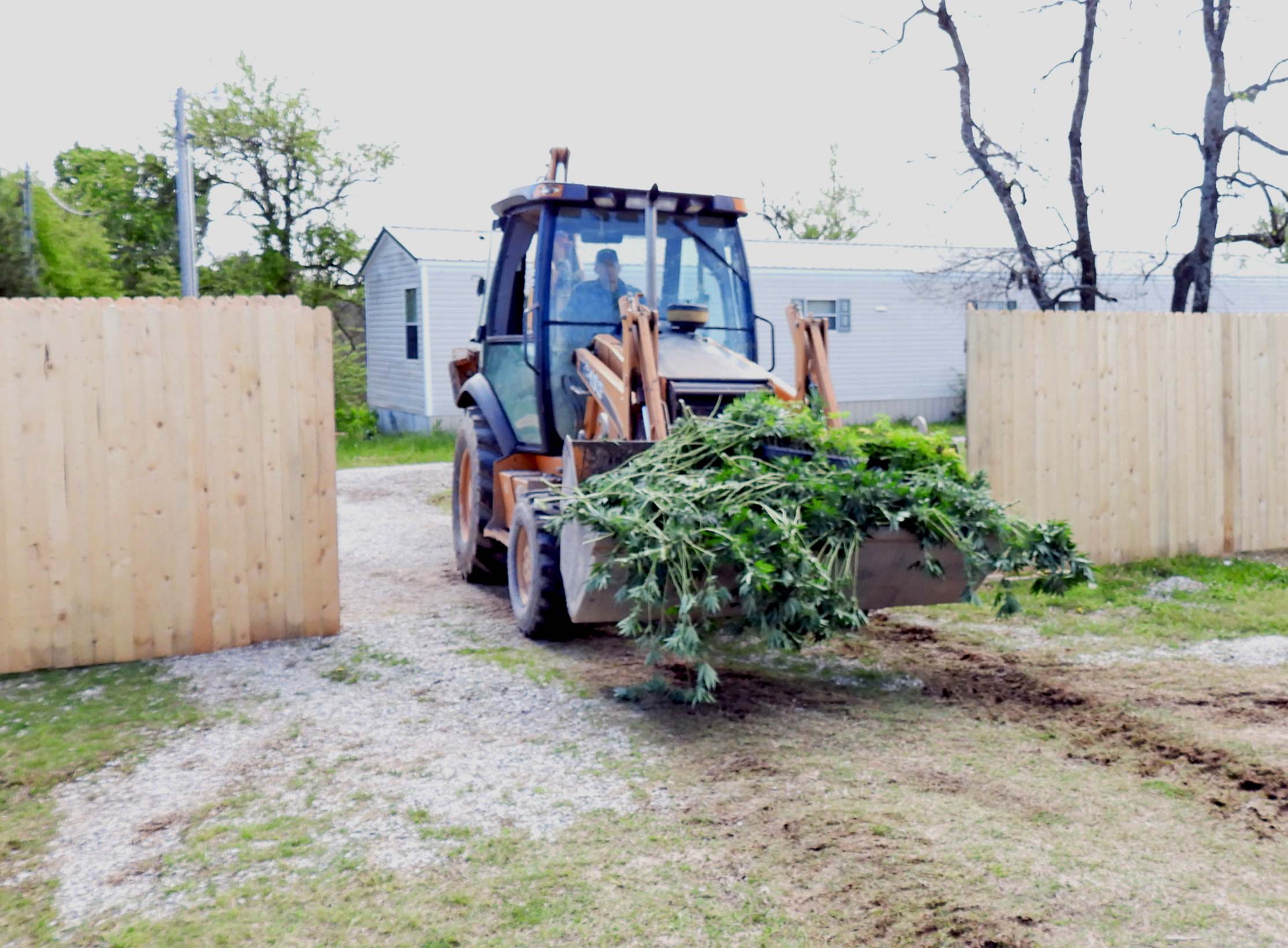
“You’re absolutely correct. I went to a bust that OBNDD did in my district and my county commissioner had to bring guys out there in two trucks and fill them full of illegal marijuana, take and go dig a pit and burn it and watch it. And they didn’t get a penny for it. That’s wrong,” Fetgatter said.
He said he’s considering legislation that would create a process for the state to seize marijuana farms that have been abandoned, usually as criminal organizations flee to avoid prosecution. The properties could then be sold at auction.
“My goal is to do two things with the money. Put it into a fund so that whoever were to buy that property at auction can have some opportunity for grants to help remediate the property, and the other half go to local law enforcement,” Fetgatter said.
Woodward added that as OBN begins to seize property and bank accounts related to illegal marijuana activity, some of those assets will be shared with local law enforcement.
“I can’t say enough about our sheriffs and our county workers. We couldn’t do this without them. They absolutely deserve every bit of the recognition that we’re getting for shutting this down,” Woodward said.
Several citizens demanded answers to why the legislature did not prevent voters from passing a state question to legalize medical marijuana when it is still illegal at a federal level, and why legislators have not addressed shortcomings in the law since its passage.
“We did not create this problem,” Fetgatter said. “This was a state question that everyone in this room voted on, whether you voted for it or against it. The citizens of Oklahoma created the problem by passing legalized marijuana.”
Sen. Greg McCortney, who represents District 13, which includes most of Garvin County, said the state legislature wasn’t in session when SQ 788 was passed in June of 2018. Their first opportunity to address the new law was in February of 2019.
“Now, I’m elected by the people, who 56% of them said, ‘We like this. This is a good idea.’ So, when I come in in 2019, the people just said they wanted it. My job is to represent the people. The people have spoken. So, I’m not going to go in and throw the whole thing out,” McCortney said. “It’s representative government. We’ve tried to represent.”
McCortney said the 2020 legislative session was consumed by the COVID-19 pandemic. When they returned in 2021, much of the criminal activity related to black market marijuana that had moved into the state was coming to light, and the legislature swung into action, passing bills that were intended to crack down on foreign nationals.
“You need to understand, this problem is worse than any of us could have predicted, but it’s even worse than really most of us can even begin to understand at this point,” McCortney said.
Currently OMMA falls under the authority of the Oklahoma commissioner of heath. McCortney said the state needs to create a separate agency to regulate medical marijuana.
“Let’s stop pretending that’s its medical. Let’s let Adria (Berry) be the actual commissioner. That way she has the authority, that agency has the authority, to be really much more of a law enforcement agency and not a health agency,” McCortney said.
“If we had known then what we know now, we could have fixed that before. We’ve had two swings at this pinata as a legislature. We’re about to have a third, and I think you’ll see us swing pretty hard this time around. I know it feels like this has been going on forever, but it’s been going on for three years, and in government terms three years is just not very long. And really, the problem has existed for a year and a half or so. Under COVID, it all really was able to go nuts.”
OMMA director Adria Berry said the current situation wasn’t unforeseeable, especially for an entirely new industry that was born out of only five pages of law.
“It’s unprecedented. I mean I think we all could look at 788 and know things were going to go terribly wrong. We’re in a position now that we have to fix it,” Berry said. “Gov. Kevin Stitt is the one who put me in this position. He asked me to come in and tell him what’s going on so he can work with the legislature and get this fixed. So, you know you have the Governor and the legislature who want to get this fixed this session. You have an OMMA director that wants to get it fixed and OBN, as well. So I’m glad you had us out here because it is at a boiling point. We all want to see it fixed too.”