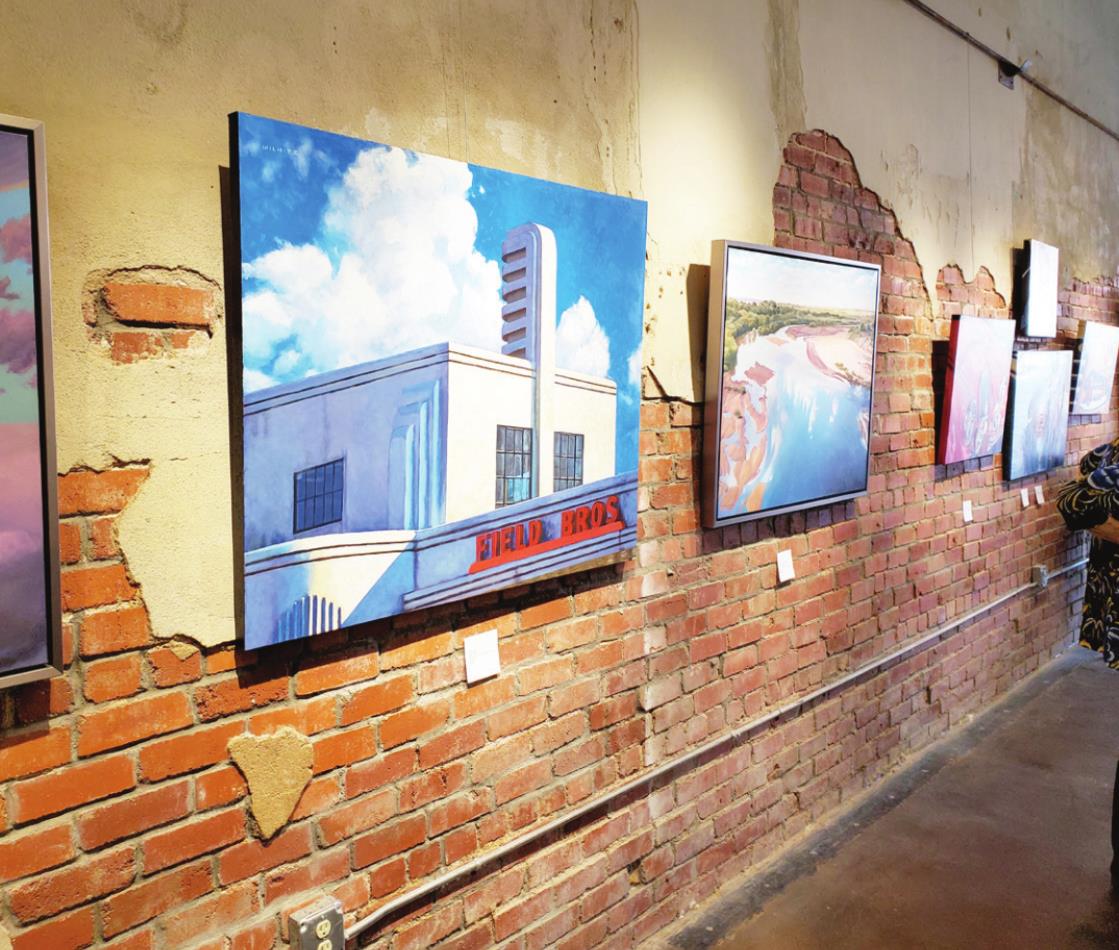
Dean Wilhite learned to find the joy in forgotten things at a young age.
Wilhite grew up in Missouri, but every summer he would spend two weeks at his grandfather’s farm in southwest Oklahoma.
“My grandfather’s farm was full of machinery and outdoors with a lot of red dirt and old crusty buildings and I developed an appreciation for old things that are forgotten,” Wilhite said. “So, a lot of the paintings I do are full of all those things. They are things people have kind of cast away and things that are forgotten, things that are no longer here.”
Speaking during an “Artist Talk” at The Vault in Pauls Valley Friday, Wilhite explained how the work he currently has on exhibit at the art gallery gave him the opportunity to capture not only the unique flavor of historic buildings in the area, but also capture images that may already be slipping away.
Wilhite pointed out his painting “Field Bros.,” which depicts the iconic service station located on the corner of Paul Avenue and Walnut Street in Pauls Valley, features the art-deco style “fin” on the top of building. The fin has been removed since Wilhite started the painting.
“Luckily I was able to take a photograph of it before it was taken down,” Wilhite said.
The fin was removed because it was leaning, causing damage to the roof of the building. Plans are to repair or rebuild the fin and return it to its home atop the station, according to the property’s owner.
Similarly, Wilhite’s painting “Scars and Bars,” depicts a building that used to sit along Highway 77 in Paoli, but no longer exists.
“I drove by there this afternoon and there’s only an empty concrete slab there now,” Wilhite said.
Wilhite took pictures of the building last August on his way to another art opening in Pauls Valley.
“That building, when I drove by it, it struck me. The way that my mind works and the way that my eyes work I am constantly on the search for the next thing I’m going to paint. The thing I look for are shadows and light. It’s not necessarily the what that I paint, but it’s how light interacts with that thing. So most of the things I paint have light interacting with that thing making very dramatic shadows,” Wilhite said.
“I was driving down 77, and I get right past that building and out of the corner of my eye I see shadows,” Wilhite said. “I whipped it around and went back and sure enough it was really interesting. And I just thought, ‘Okay. This is the next one.’ So I took pictures of it.”
At the time, he was planning for his show here and knew he wanted much of his work to be of this area. So he took some time that evening and “walked down every alley and in front of every building looking for ‘that thing’ that might be a painting. I knew the light was pretty interesting when I was here that day, and I just started walking around.”
Many of the paintings in this exhibition feature brick walls, but Wilhite said it’s not really about the bricks.
“The bricks are the vehicle that tells the story of the main feature of the building. If I want to paint a fire escape with dramatic shadows, I have to paint bricks. There’s really no way around that.”
Wilhite said his process (in all his work – painting and otherwise) is to do the things that are the most difficult or unpleasant first. Then the reward is the thing he really wants to do.
“I find I have to tease myself in to doing the thing I need to do, by holding off on the thing I really want to do. If I paint the thing that I really enjoy first, then I’m not likely to want to paint the thing that I don’t enjoy.”
Wilhite said he really doesn’t want to paint a whole building, but rather just a portion – a side or a wall, or often times a window.
“I really love windows. Windows are a portal to another place. It’s a way of seeing into your imagination: what’s on the other side of that window, or who’s on the other side of the window, what’s happened on the other side of the window or door.”
Wilhite said he knew even back on his grandfather’s farm that he wanted to be an artist. He said he can remember in kindergarten, a kid across the table was drawing a picture and he looked across and thought, “I can do better than that.”
From that point on he drew every chance he could.
“Art just became the most important class, or segment, of grade school. I wasn’t happy if I wasn’t drawing, and I wasn’t happy a lot because they made us do other things, math and reading and all that stuff. I was like, ‘who has time for this? I want to draw.’”
“That need to show off, that need to have bragging rights about my ability to be a person who could draw and create was strong even back in grade school. It became my identity. The guy who could draw stuff.”
“I was always looking for that one thing that I could do that no one else could do. That’s what drove me to do the artwork thing, it drove me to learn how to juggle and to ride a unicycle and you know all the things you can do physically that not everybody can do, I wanted to learn how to do that. And so I did it.”
He said his motivation to paint now is different.
“I relish in that experience of seeing something that is gonna make me happy while I’m working on it and when I’m done,” Wilhite said. “It gives me a joy. It gives me some happiness, and being able to translate that to other people is very important to me. I love being able to bring other people a kind of joy like that too.”
Wilhite’s work will be on display at The Vault through July 31.