Things are a little clearer in Maysville this week, both in terms of the water flowing from faucets and the explanation from town officials as to what caused the town’s municipal water to be brown and muddy in the first place.
Maysville residents have been dealing with the brown water for several weeks, taking to social media and local television stations to share pictures and stories of ruined laundry and muddy sinks as they waited for information to come from town officials regarding the cause and a timeline for a remedy to be implemented.
Official explanations have offered little detail and have cited mechanical failures at the water plant, including a broken clarifier, which helps to remove solid impurities from the water, and corrosion in cast iron water pipes for causing the issues.
Though Maysville citizens were reporting water in some areas of town was visually clearer earlier this week, a precautionary boil advisory issued July 17 remained in effect on Wednesday, with residents encouraged to boil tap water prior to consumption.
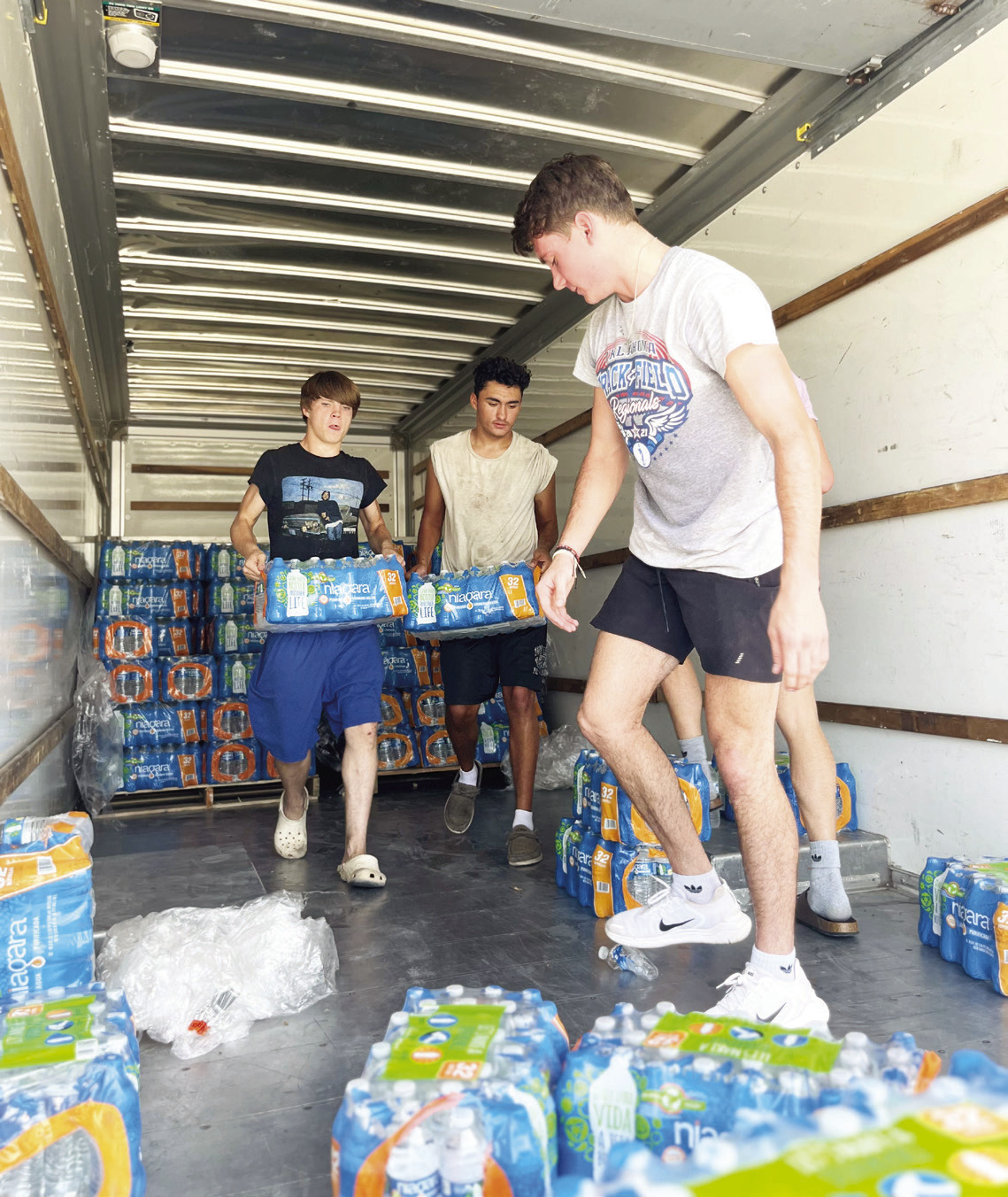
Town officials and volunteers began working to distribute donated drinking water to residents late last week.
Local businessman Don McCaskill also pledged drinking water to help Maysville residents, staging a pick-up location in Maysville Monday where residents could get free cases of bottled water. McCaskill also donated $5,000 to Maysville Public Schools to assist with the purchase of drinking water for students and staff as the new school year gets underway next week.
The Maysville Board of Trustees held two meetings last week to address agenda items related to the town’s water service. Both were packed with residents expressing frustration and demanding answers.
During a special meeting July 26, Dale Burke of Infrastructure Solutions Group, the engineering firm engaged to work on an ongoing waterline replacement project and a planned rehabilitation of the town’s aging water plant, spoke on projects currently underway.
Burke said the town has been working on a $4.5 million project to replace Maysville waterlines and erect a new water tower, which will improve water pressure for residents. Burke said over half of that project is funded through grants from Rural Development and Indian Health Services.
“Right now, you can’t fill the current standpipes (towers) you have because your lines blow out, all the leaks and everything else. So, this is supposed to fix that,” Burke said.
Trustee David Uhles spoke to the age of waterlines that have yet to be replaced.
“All the water we’re pushing from our plant is going through 50-year-old water lines. That’s part of our water quality problem right there,” Uhles told residents.
“It doesn’t matter what kind of water we produce at the plant. Until we get the water lines done in town, we won’t get the best quality water we can.”
The town is also expected to receive grant funding that will assist with a planned project to refurbish Maysville’s aging water plant. That project carried a $3.8 million initial capital cost when it was approved by the Board of Trustees in September of 2022.
Burke said the town is still waiting on those funds to be disbursed before the project can be started. He said the EPA, which administers the grant, has not been able to furnish a disbursement date yet.
“Thank the Lord we got the grants we did, or we couldn’t even be talking about this right now,” Uhles said. “I don’t even know what we’d do if we didn’t have these grants. This board sitting here in front of you has been working for the last three years to get this together. It’s going to take time.”
Focusing on the current condition of the water coming from the taps in their homes, residents in attendance asked the board how much longer until they could expect relief from the murky water coming from their taps.
Uhles said crews were working to flush water lines and to establish an emergency water supply by tying into one of two nearby rural water districts.
When residents asked what had caused the brown water to begin with, Uhles deferred to David Deviney, who has been working with the town part time for the last two weeks to help remedy the current issues.
“This is not a hundred percent, we know for sure, but this is the best we can deduct out of what happened,” Uhles prefaced before handing the floor to Deviney.
“You really want me to tell them what happened?” Deviney asked Uhles.
“We’re here for transparency and truth. That’s all we want,” one resident said.
Deviney said the water storage tower at the water plant is aging and not in good shape. He believes rust from the tank fell into the water.
“Our system is so old, when they were backwashing the filters, some of the valves didn’t shut all the way and I think it leaked by and it got some in there and then it got sent to town. And then you’ve also got old lines and no one was flushing lines.”
Residents asked the board why it had taken so long to get an explanation from town officials.
“We didn’t have the answers to give you yet,” Uhles said.
In an emergency meeting July 28, trustees approved connecting to Garvin County Rural Water District 4 to provide back-up water to the town.
Mayor Cindy White made a motion to approve the connection and David Uhles seconded the motion, before Trustee Janet Davis stopped the vote to question what the cost on the item would be. Uhles told her he had an estimated cost, which the board would address when they took up the next agenda item.
“We have to have water. We have to have a backup for the people when our water’s messed up. So, this is what we have to do. And this is why it’s an emergency meeting,” White told Davis.
Uhles then said the project would cost about $50,000.
Trustees Anita Uhles, David Uhles and White voted in favor of the motion to establish the emergency connection, with Davis voting no.
Under the next agenda item, David Uhles reiterated the cost and estimated the connection could be up and running within a week.
“So therefore, if we need to take our plant down and clean it and work on it, we can actually do it,” Uhles said.
Davis reminded the board when they considered whether to make connection to Rural Water District 4 last September, the cost was projected at around $4 million. She asked what had changed.
“If we ever want to get a big, huge main coming in here, it would cost that,” Uhles said. “But everybody put their heads together. We found some lines that already went almost up to rural water that weren’t being used that are in good shape.”
Deviney and Jerry Dunn, manager for Rural Water District 4, explained they knew the lines were there previously, but they were private lines and not the town’s lines to use. They said in the last week they have been able to secure permission to use them.
Trustees unanimously approved the use of up to $50,000 in American Rescue Plan Act funds to complete the connection.