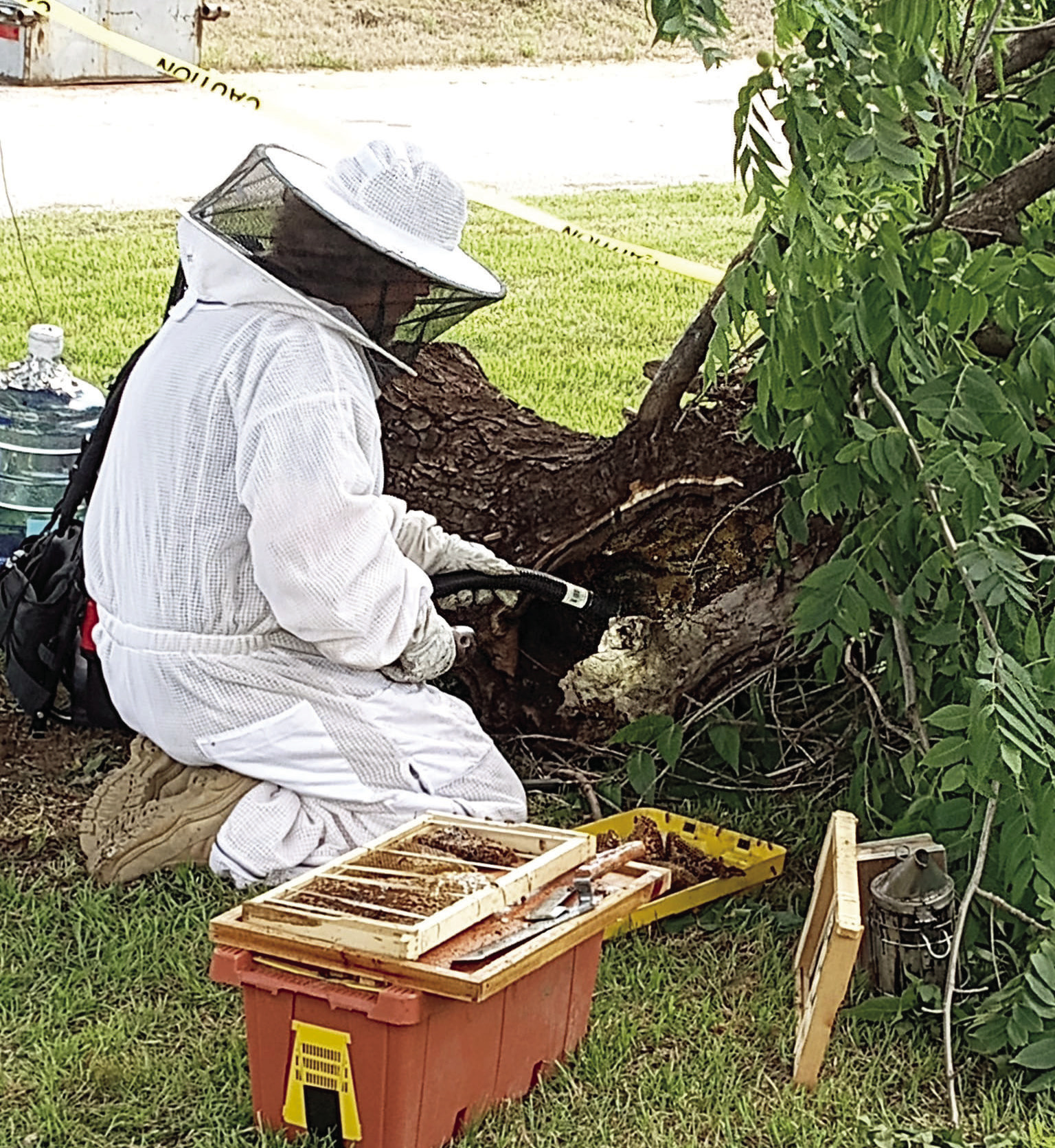
A Maysville man who survived a three-hour bee attack that left him with a broken leg and hundreds of bee stings said he wants people to be aware of the dangers Africanized bees.
Carl Amos, 81, was mowing the lawn at his home on Highway 74 just north of Maysville on the morning of May 26 when he noticed a few bees flying nearby. He went to retrieve a can of bug spray from the front porch, intending to chase the insects away.
That’s when he says he was overwhelmed by bees.
“All of the sudden they were right down on top of me,” Amos said.
He tried to run, but tripped and fell in the driveway, breaking his leg just below the hip.
Amos said the bees were all over him, crawling in his ears and nose, and under his clothes.
With no one else home, and the bees continuing to sting him, he knew he was in trouble.
“I thought to myself, ‘If I ever had to be tough, this is it.’” Amos said. “They were just all over the place.”
Amos said he was about 50 yards from the highway and could see people passing by but was unable to get anyone’s attention. He tried firing three shots from the gun he had been carrying to signal for help, but to no avail.
He could feel his face swelling from the stings, the pain was excruciating, and he said the bees seemed to be continuing to multiply.
His voice breaks as he recounts the desperate prayer he uttered, “Lord, I need some help. I need you to help me, now.”
Finally, Amos said, he saw a young man, who he now knows was Tim Brammer, approaching.
“He said, ‘I’m here to help you. I’m going to help you, buddy.’” Amos said Brammer received stings, too, as he tried to help, “but he stayed with me.”
Brammer was one of several employees from the nearby Burford Corporation, who finally saw Amos and came to his aid, calling 911.
Amos believes he would not have survived if they hadn’t helped him when they did.
“I heard the ambulance coming and I thought, ‘I’m going to be okay. Hold on, hold on,’” Amos said. “I’m thankful the good Lord helped me out, and I’m grateful for those people.”
He was rushed to a Norman hospital where he was treated for hundreds of bee stings and underwent surgery for his leg. He’s now continuing to recuperate at a rehabilitation facility.
Amos and his family believe the bees that attacked him were Africanized honeybees, sometimes called ‘killer bees,” and known for their aggressive behavior when threatened.
Amos said he never saw a nest or hive but he had previously observed bees around his chimney, although he’d never had a problem with them before. Those bees have now been professionally removed.
“The main thing I want people to know is we have these bees here, and this danger is out there,” Amos said. “The word needs to get out. These bees are different. Once they get after you, they are relentless.”
What are Africanized honeybees?
Africanized honeybees are hybrid bees created from crossing European honeybees, or what most of us think of as regular honeybees, and African honeybees, which are more aggressive.
Africanized honeybees originated in Brazil in the 1950s, bred by a geneticist hoping to create a bee with the higher honey production of African bees while retaining the more docile nature of European honeybees.They were unintentionally introduced into the wild, spreading north through Central America and Mexico eventually reaching the United States.
The first Africanized bee colony in the United States was identified near Hidalgo, Texas, in 1990.
According to information on Oklahoma State University Extension’s website, over 100 counties in Texas, 10 counties in New Mexico, 14 counties in Arizona, 3 counties in Nevada, and more than 10 counties in California have Africanized honeybees today.
In Oklahoma, 43 counties have confirmed the presence of Africanized honeybee populations through DNA since 2004, including Garvin County.
Honeybees with Africanized traits look just like their more docile European counterparts, making it nearly impossible to tell the difference visually. According to OSU Extension, only laboratory analysis can conclusively determine whether a honeybee has Africanized DNA.
The distinguishing feature of Africanized honeybees is their behavior. They respond more quickly and more aggressively to threats, can sense a threat from people or animals 50 feet or more from their nest, sense vibrations from power equipment 100 feet or more from their nest, may pursue a victim a quarter to half mile, and remain agitated for an hour or more after an attack. Experts recommend those involved in outdoor activities be aware of their surroundings and keep an eye out for bees. Don't panic at the sight of a few bees foraging in the flowers.
Bees are generally very docile as they go about their work. Unless you do something out of the ordinary, such as step on them, they will generally not bother you.
Information sheets available at OSU Extension’s website suggest a few things you can do to be proactive.
•Wear light-colored clothing. Experience has shown that bees tend to attack dark objects such as clothing or hair.
•Avoid wearing floral or citrus aftershaves or perfumes when hiking. Bees are sensitive to odors, both pleasant and unpleasant.
•Check around your house and yard at least once a month to see if there are any signs of bees taking up residence. Africanized honeybees will live about anywhere they can find shelter.
This means they are more likely to be found in trees, in the sides of buildings, in drain pipes, in water meter boxes, in old abandoned appliances, in piles of junk, and even in holes in the ground. Sealing or covering cracks and holes in houses is good prevention.
•Don't panic if you find an established honeybee colony in your neighborhood. Keep everyone away. Contact a local pest control operator, beekeeper or other bee removal expert in your area who will remove the colony. Do not try to remove colonies yourself.
Experts say the best safety advice is to avoid any encounters with unfriendly honeybees. Be alert for danger especially if bees are acting strangely.
Remember that honeybees sting to defend their colony, so be on the look out for honeybee swarms and colonies.
Quite often bees will display some preliminary defensive behavior before going into a full-fledged attack. They may fly at your face or buzz around over your head.
These warning signs should be heeded, since the bees may be telling you that you have come into their area and are too close to their colony for comfort both theirs and yours!